Since we
are still huddled together in the toxic shadow of Valentine's Day, I suppose
it's appropriate to write about breaking up.
Surely, thousands of VD survivors waited until after the holiday to move
all their stuff out of apartments and disappear in U-Hauls; get caught cheating
on purpose; send goodbye e-mails (or texts); or, hell, just break up face to
face like people did before Nikola Tesla kindled the world's ruin with
electricity. Thus? In honor of the colors red and gray, let me
begin at the end of the middle.
Katarina stood six feet tall in heels, and she always wore
heels (flats made her calves hurt). She
had dark brown hair and eyes. Her broad
features were finely sculpted; her skin was the color of cinnamon. She looked like a statue standing outside the
doorway to Desire. I know that sounds
mawkish, but she was Russian. When we
started seeing each other she had just turned thirty-six—exactly twice my age. The relationship lasted about nine months and
remained rocky, twitchy, and sticky pretty much the whole time given that she
was married, had two kids, and worked as my direct supervisor at Bank One,
where I answered credit card application phone calls for ten hours every
Saturday. Mid-1980s. Dayton, Ohio.
Again.
At the time, I was ready for anything, mainly because I was
lonely. Most people don't want to know
anything about loneliness. Real
discourse on the subject is more taboo than alluding to the specter of nuclear
war: Ignore it, and it might go away.
Yet loneliness makes most of our decisions for us. Bodies collide because of it. Cable channels propagate because of it. Pharmaceuticals slide down esophagi when we
can't endure another day of it. Alcohol. X-Box oblivion. Gambling.
A rusty knife hacks away at us from the inside, and we surrender to our
most meager ambitions. Anything to
deaden the pain. I'm probably speaking
for myself here—because I want to feel better.
And that sole aspiration, in all its casts and configurations, has been,
despite what I say or do, the story of my life.
Katarina was up front about everything: I should avoid
calling her at home during the evening; no one must know, not even my closest
friends; we would see each other on Thursdays at a pre-designated location; my performance
at work must not suffer; she didn't want to catch any diseases, so I wouldn't
be permitted to have a girlfriend. It
crossed my mind that she'd had affairs before, but I didn't care. Or at least I thought I didn't care. I marveled at my becoming as dark and disastrous
as all the poets I admired. And maybe
Katarina felt shipwrecked in adulthood or her husband neglected her. Maybe she wanted to simulate a courtship and
recreate the onset of love, something she feared she might never again
experience. Whatever the reason, it was
apparent that we'd risen (or sunk) to the same level of incautious need.
We started out meeting at a motel not far from my dormitory
at the University of Dayton. It was cheap, but it wasn't nasty. The sheets and pillows smelled clean, and a
small refrigerator kept our beer and vodka cold. She paid for the booze, and I paid for the
room. My student loan money had to be
good for something. This became our custom,
our ritual, though I couldn't always afford the motel. Sometimes we went to my mother's government-subsidized
apartment in Centerville,
if she was sleeping at her boyfriend's, and barricaded ourselves in the extra
bedroom. Being seen as smart and
handsome by this educated older woman made me feel like a prospect. In exchange, I presumed that I injected a
sense of yearning and machination into the flagging drama of her life. Scandling with my boss sparked a tangle of
hot crossed wires. Not falling in love
seemed petty.
For the record, I never once laid eyes on her husband, and
she rarely spoke of him. I can't even
remember his name. I do recall that he
worked as an engineer at Wright-Patterson Air Force Base, which doubtlessly made
him, politically, a hawk. As a result, I
experienced less remorse. Besides, Katarina
had kept up with her wifely duties, although she insisted she couldn't come when
they slept together. Thankfully, reflections
of the two of them in their marriage bed never flooded my mind when I sat down
to study or write the occasional poem.
The husband was a given, a fact of life.
Every older woman seemed to have one.
In this way, I maintained a certain distance. I can't say I felt like a victim any more
than I can say I felt like an interloper.
These days, however, I could never imagine entering into such a deceitful
situation. Lying is a dissociative
art. The act debases one's sense of
identity, which is already precarious enough.
By and by, the isolation inherent in an adulterous
relationship took its toll on me, and I began to retreat. I stopped abandoning my own routine whenever Katarina
wanted to see me. Visits to the motel dropped
off. I waited longer and longer to
return her phone calls. When we did get
together, we usually had lunch at some monotonous restaurant, and she would
gaze at me with this sad look in her eyes, as if I were dying of cancer or
going off to war. I started missing work
and she let it slide.
The summer before my sophomore year, I decided to buy a
car. I hadn't really minded walking,
taking the bus, or borrowing my mother's Pontiac Le Mans. Then I realized that without a set of wheels
I might as well be incarcerated.
Katarina seemed impressed by my sudden desire for ownership, and though
I knew we weren't going to stay together much longer, I still wanted to please
her. But I didn't have a great deal of
money to spend. Maybe I could afford
some rusted-out piece of junk. Coincidentally,
her father had driven down from Nebraska
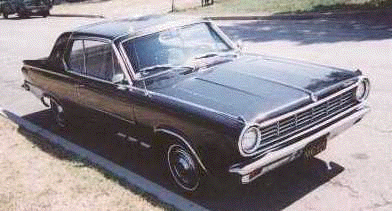
in a 1965 Dodge Dart he'd wanted to sell for the past several months. On the telephone one Thursday afternoon, she
told me the vehicle was in good shape, no serious body damage, and obviously it
ran well if her father had driven all the way from Nebraska.
"How much does he want for it?" I said.
"Three-hundred dollars," she replied.
"What's the catch?"
"His dog has been sleeping in the back seat. The upholstery isn't perfect."
"How bad can it be?" I said hopefully.
She assured me that her husband wouldn't get home from work
until at least six o'clock, so I withdrew three-hundred dollars from my bank
account and took bus D14 out to their place in Kettering,
yet another suburb of Dayton. But for the driver and a blind man I'd seen
around town asking everyone if he could touch their face, I was the only person
on the entire bus. I sat in the very
back seat, just like in grade school, and peered out the window at an
absolutely unprepossessing city. The bus
dropped me off about a mile from my destination, and I walked down a brand new,
tree-lined street. I was sweating when I
reached Katarina's driveway and saw her sitting on the front steps of the red
brick, two-story house she'd described on the phone.
Her father stood near the Dodge Dart sedan, smoking an
unfiltered cigarette and mumbling to himself in Russian. Katarina jumped to her feet and headed me off
before I could introduce myself. She
said something to him in Russian that I couldn't translate; he held out his
gnarled hand, and I shook it. I had
heard that he'd served in the Red Army during World War II and that he still
drank a quart of vodka every day and sometimes stepped out on his wife. His ferocious green eyes told the whole
story. Unedited and unrepentant.
"Drive!" he barked, and Katarina wrenched the keys
from her jeans pocket and tossed them to me.
"We'll just go around the block," she said.
When the two of us got into the car, leaving her father
standing near the garage, I quickly acclimated to the various knobs and pedals
so I wouldn't look like a neophyte in front of the Russians. I started the engine and smiled at the
antique rumble, inched out of the driveway, and coasted up the street toward
the nearest stop sign. It was really a
nice old car. Big steering wheel. No blinking red gas tank and seat belt guy on
the instrument panel. In spraying Lysol
everywhere and covering the back seat with a blanket, Katarina had done an
excellent job of masking the dog smell.
By the time I made the first turn, I'd already decided to purchase the
vehicle.
"When I was eighteen," she interjected, "I
used to take this out on the weekends in Chicago." She seemed so happy that I would consider
buying her father's car. I couldn't help
getting swept up in the rejuvenating excitement, despite the truth about our
age difference having accessed my heart.
I felt guilty—like the man who ditches his fiancé after she gets
disfigured in an automobile accident.
As we rounded the final corner, she told me to stop by the
side of the road, and I complied, though I didn't kill the engine. She pulled a black and white photograph out
of her back pocket and handed it to me.
"That's a picture of me taken around the time you were born,"
she said. I stared at the picture and
struggled to hide my astonishment. She
looked excruciatingly beautiful. She had
on a striped tank top that accentuated her breasts, and she was wearing
sunglasses. Immediately, I yearned for
the untarnished, unmarried Katarina, though I knew the woman in the photograph
would never have been attracted to me, would never have loved me, under any
circumstances. Sensing my reaction, she
yanked the evidence out of my hand with a comic flourish and slipped it back in
her pocket.
"So what do you think?" she said.
"Of the picture?"
"No, the car," she said impatiently.
"Well, I guess I'll take it," I said, and she
smiled broadly. She might even have
clapped her hands together.
The old man was loitering in the middle of the driveway, so
I parked along the curb in front of the house.
After Katarina located the title in the glove compartment, we climbed
out of the car. Her father walked over
and squinted at me until I reached for my wallet and ceremoniously passed him
three large bills, which he handled a little too carefully with his tawny
fingertips. He nodded and then sidled up
next to the sedan, whispered something in its ear, and shuffled silently back
to the house.
"He's had that car since it was new," Katarina
lamented.
Without a kiss goodbye, I drove away in my jet-black Dodge
Dart, cruised up Far Hills, and took a right on Stewart. The sky had faded to a very light, Midwestern
gray, the color of an abraded fifty-cent piece.
As I drifted down a narrow side street toward campus, I brushed my hands
over the steering wheel, thinking I should buy one of those leather racing
grips you can find on sale at K-Mart.
The steering wheel's original plastic finish had begun to crack. I remember considering these particulars when
I noticed the smell. At first, I assumed
the musty blanket had reacted with the aerosol spray to generate an old
unabridged dictionary bouquet. But the smell
kept getting worse and worse. Defeated
little Lysol soldiers lay dead and desecrated on the olfactory field of battle. I cranked down the window a few turns, and
then I cranked it down a few more. I
scrunched my nose and breathed through my mouth to fend off what had become a
full-scale stench. Unbearable.
When I finally arrived at the dormitory parking lot, I
jumped out of the car and stood for a moment.
Then I walked around to the passenger's side door. I grabbed the handle and flung the door open
and the odor hit me even harder—like a backed-up Kentucky outhouse on the hottest day of
summer. I tore the blanket off the back
seat, and what I saw I never want to see again.
The vinyl stitching had rotted away, and the metal innards, the coils, were
strung with about ten-thousand yards of filthy dog hair. Katarina had ventured to clean up a lot of
the actual dog feces, but she couldn't reach all of it. The animal had obviously been living in the
vehicle, not just sleeping in the back during road trips. I started to gag, so I shut the door and
staggered to my room.

Inwardly, I knew my relationship with Katarina dangled at
the end of a rope made of dog hair. I
had to call and confront her about the sedan and ask for my money back. We broke up right after she delivered an agonizing
sermon on the irresponsibility of youth and fired me on behalf of Bank One. As an impulsive juvenile, I believed that love
should end with an exclamation point instead of an ellipsis, especially if I
felt wounded or perplexed. I wanted to
leave a burning car in her driveway, but I refrained. I simply exchanged the Dodge Dart for a check,
signed by her husband, and moved on to the next transitory misadventure. Still, a burning car. That would have lasted forever.