I don't know any more what it used to be
Before I saw you at table sitting across from me
All I can remember is I saw you look at me
And I couldn't breathe and I hurt so bad I couldn't see.
I couldn't see but just your looking eyes
And my ears was buzzing with a thumping noise
And I was scared the way everything went rushing around
Like I was all alone, like I was going to drown.
There wasn't nothing left except the light of your face,
There might have been no people, there might have been no place,
Like as if a dream were to be stronger than thought
And could walk into the sun and be stronger than aught.
Then someone says something and then you spoke
And I couldn't hardly answer up, but it sounded like a croak
So I just sat still and nobody knew
That since that happened all of everything is you.
— Edwin Denby (1903- 1983).
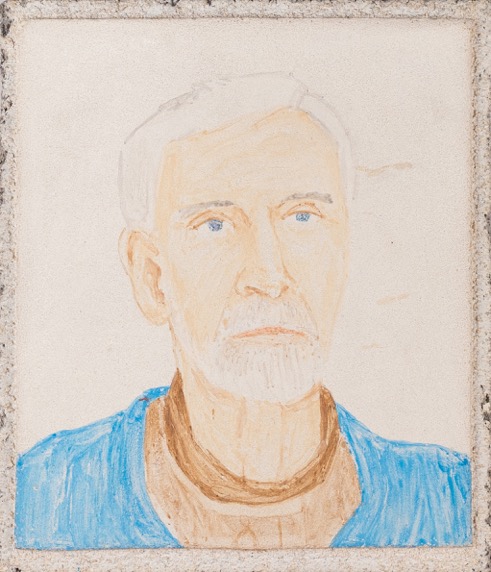
George Schneeman, Edwin Denby, 1977, fresco on cinder block. Private Collection, New York
<<< Once when we were having lunch at the Oyster Bar in Grand Central Station, I complained to Edwin about hearing myself on a tape of some recent poetry reading. “Yes,” Edwin said matter-of-factly in his customarily soft, slightly gravelly voice, “that resentment tone.” Thinking back on it over the years, I may not have understood the intriguingly commiserating aspect of Edwin’s remark. Another time I wondered aloud to Alex Katz about how few, if any, new poems by Edwin were appearing. As Ron Padgett put it later, “He kept revising his new pieces out of existence.” I had seen Edwin’s notebook open on a table in his Chelsea loft—two pages of lines in black ink, almost all crossed out. “He’s conceited,” Alex said. “He thinks he’s better than we are.” What Alex meant, I think, is that Edwin’s standards wouldn’t allow him to write the sometimes awful stuff that most poets need to write to get to the good things, the poems, anyway, that one can bear.
Encouraged by his heroes de Kooning and Balanchine, and by continuously re-reading the poetry of Whitman and Dante, Edwin set himself very high standards, indeed. In de Kooning’s paintings he found himself reacting to “the beauty that instinctive behavior in a complex situation can have—mutual actions one has noticed that do not make one ashamed of oneself, or others, or of one’s surroundings either,” then commented, “I am assuming that one knows what it is to be ashamed. >> — Bill Berkson. For more of Bill's reminiscence, click here. >>