
108 minutes
Color
Color
5.1 Surround
in Spanish
1:85:1 aspect ratio


“What is a ghost?”
Answer: almost every character in this masterful film.
Del Toro plants a terrific red herring early on — which make repeated viewings so pleasurable and rewarding!
Set during the chaos of the Spanish Civil War, we observe the arrival a big 30’s car driving down a dusty road to an orphanage in the middle of nowhere, depositing a young boy, Carlos (Fernando Tielve), and his injured tutor. Casually, we also see Jacinto (an exceptional Eduardo Noriega) — an orphan who is now a grown man, acting as the caretaker, and his gigantic sidekick, The Pig (Paco Maestre).
The war is everywhere, but unlike Del Toro’s Spanish Civil War companion pic Pan’s Labyrinth (2006), we never see any actual fighting. We see a bomb drop from a plane — it lands unexploded in the orphanage’s courtyard, apparently subsequently defused.
We meet Dr. Casares (Federico Luppi) and Carmen (Marisa Paredes), the headmistress. We meet Conchita (Irene Visdeo), Jacinto’s lover and the boys, headed by a bully named Jaime (Íñígo Garcés) and the story takes off.
**
Del Toro is the kind of filmmaker who not only thinks through every single frame, but is such a polymath that he is able to draw on hundreds of varied sources to bring his material to life (see Commentary below). He was planning this screenplay even before he made his debut film, Cronos (1993) [starring Luppi] …
Produced by the Almodóvar brothers (Pedro and Agustin) and featuring an excellent subtle score by Javier Navarrete. Also incredible sound design by Salvador Mayolas.
Not a boring or inconsequential frame in 108 minutes.
A few influences which Del Toro mentions in his “rambling commentary":
- The Castle of Otranto by Horace Walpole
- Luis Buñuel
- Tom Thumb
- Thumbelina
- Hansel and Gretel
- Giovanni Battista Piranesi
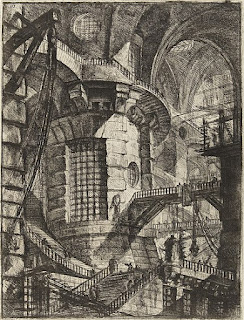
- Carceri d’invencione (Imaginary Prisons)
- M.C. Escher
- Symbolist painters
- Death and the Grave Digger
- Death and the Grave Digger
- Surrealist painters
- Lord Byron
- “If you cannot move them emotionally or intellectually anymore, just shove them.”
- Roger Corman
- William Castle
- The Monk by Matthew Gregory Lewis
- Frankenstein by Mary Shelley
- Wuthering Heights by Emily Brontë
- Charles Dickens
- M.R. James
- Arthur Machen
- The Willows by Algernon Blackwood
- Robert McKee [negative connotation]
- [in case you didn’t notice]: All the “good” characters’ names start with “C” (Carmen, Casares, Conchita, Carlos) and the “bad” ones with “J” (Jacinto, Jamie)
- The Sandman by E.T.A. Hoffman
- Mark Twain
- Beauty and the Beast by Gabrielle-Suzanne de Villeneuve
- Alfred Hitchcock
- Pedro Infante
- Deep Red by Dario Argento
- The Sixth Sense (M. Night Shyamalan)
- The Eye (Pang brothers)
- The Ring (Hideo Nakata)
- The Grudge (Takashi Shimizu)
- May (Lucky McKee)
- Blair Witch Project (Daniel Myrick and Eduardo Sánchez)
- The Searchers by John Ford
- Mario Bava
- Sergio Leone
- Honoré Fragonard
- Horseman of the Apocalypse
-
- Alfred, Lord Tennyson
- Juana Inés de la Cruz
- The Wild Bunch by Sam Peckinpah
- Marquis de Sade
- Ann Radcliffe
- Goths
- Tango


