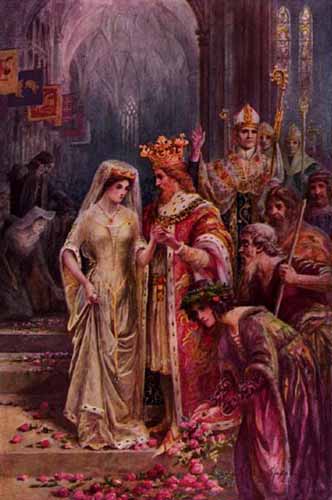
The Marriage of King Arthur and Queen Guinevere
*
King Arthur and the Knights of the Round Table (Part Two)
T. S. Eliot paid Tennyson a decidedly left-handed compliment when he marveled at how the Poet Laureate of Victorian England had “adapted this great British epic material” and made it “suitable reading for a girls’ school.” There’s some truth to this; Tennyson valued piety as assistant professors today value subversiveness. Nor is narrative his strong suit. Still, his peerless ear offers ample compensation. When Arthur weds Guinevere, it’s in a perfect pentameter line: “Let chance what will, I love thee to the death!”
The triple iteration of “May” that precedes the exchange of marital vows is exquisite: “Far shone the fields of May thro’ open door,/ The sacred altar blossom’d white with May,/ The sun of May descended on their King, / They gazed on all earth’s beauty in their Queen.”
Idylls of the King follows Malory in opening with the “coming of Arthur” and closing with his passing. Most medieval romances take place somewhere between these two poles, but in most Arthur is a background figure, at best a figurehead, at worst a cuckold. Yet some of these works far exceed Malory in literary greatness. Wolfram von Eschenbach’s Parzifal and Gottfried von Strassburg’s Tristan are unsurpassed renderings of the quest for the Holy Grail and the love story of Tristan and Isolde.
Undoubtedly the finest Arthurian narrative in medieval English is Sir Gawain and the Green Knight by an unknown poet writing at the end of the fourteenth century. A giant of a man, green in hue from top to toe, rides into Camelot and challenges any knight to “exchange one heavy blow for another.” Sir Gawain accepts. The Green Knight gives Gawain his battle-ax and awaits the first blow without armor. Gawain strikes, the giant’s “handsome head fell from the neck to the earth,” and yet “the knight never staggered or fell.” Calmly he picks up his head and rides off saying he expects his rematch in one year and a day.
And that’s just the beginning. W. S. Merwin’s verse translation of Sir Gawain and the Green Knight (2004), which I’ve been quoting, renews the conviction that this medieval romance is one of the glories of world literature.
